

Crowd Safety & Security
Crowd safety is an engineering problem before it is a manpower problem. A crowd behaves according to the geometry it is given: the width of the gate line, the gradient of the approach and the position of the merchandise unit that nobody put on the drawing. No quantity of stewards will steward you out of a site layout that is wrong. We therefore begin every appointment with the plan, not the roster, and we have on more than one occasion asked a promoter to move a stage nine metres rather than sell him forty additional staff.
MGH Production has held an SIA Approved Contractor Scheme registration since the scheme opened, and provides crowd safety and security services at over 400 UK events each year. Personnel identities, duty rosters and event assignments are withheld from the public website.
What we provide
- Door supervision and guarding. SIA-licensed personnel across front-of-house, pit, gate line, back-of-house and overnight asset protection. Licence numbers are recorded against every shift and audited weekly.
- Crowd management planning. Capacity calculations, zoning and holding-area design prepared to the Green Guide, with a written crowd risk assessment issued to the client and to the Safety Advisory Group.
- Ingress, egress and flow-rate modelling. Gate-line throughput, staged egress and emergency evacuation timings modelled against the published site drawing, re-run whenever the drawing changes, which it does, on average, 4.7 times per event.
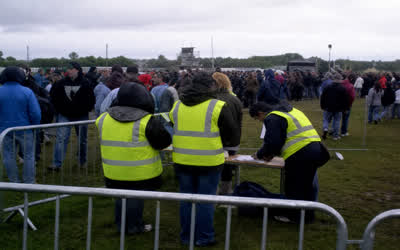
- Search and screening lanes. A hand-search lane sustains 720 persons per hour with two searchers; an archway lane with two searchers and a hand-held detector sustains 1,440 per hour. We size the gate line from those figures and not from the number of lanes the client would prefer to pay for.
- MGH Canine. Fourteen explosive detection dog teams, based at Dunstable and Warrington, each re-licensed annually by an independent assessor. Teams are deployed on pre-event sweeps and on random vehicle screening; no team works more than six hours in a twelve-hour period.
- CCTV and the GOLDCELL™ event control room. A demountable, self-powered control room delivered on two vehicles, from which the event is actually run.
- Counter-terrorism awareness briefings. A 90-minute briefing for client staff, contractors and volunteers, delivered on site in the week before doors. 214 briefings were delivered in FY02/03.
GOLDCELL™ event control room
| Specification | GOLDCELL Mk III |
|---|---|
| Camera inputs | 64 analogue, matrix-expandable to 96; 16 encoded for remote view |
| Radio talkgroups bridged | 12, including police, ambulance and the client's own NETLINK™ groups |
| Operator seats | 6, plus a Silver command position and one observer seat |
| Incident log | MGH form F-114: sequential, write-once, timestamped to UTC; printed and countersigned at close of event |
| Recording retention | 31 days as standard, extended to 90 on written request |
| Power resilience | Dual-fed from separate distribution boards with 40-minute online UPS and automatic changeover |
| Deployment time | 4 hours 20 minutes, arrival to handover, with a four-person crew |
 Download the GOLDCELL datasheet (PDF, 412 Kb)
MGH will not accept a security-only appointment where the client has declined to commission a written crowd risk assessment, whether from this company or from a competent third party. Stewards deployed against an unassessed plan are not a safety measure; they are witnesses. This position has cost us three appointments and an estimated £418,000 of fee income in FY02/03, and it will continue to.
Staffing, licensing and training
Every operative presented to a client holds a current SIA licence, verified against the public register at engagement and re-checked at 28-day intervals; a licence that lapses removes the holder from the deployment system that night, without discussion. Approximately 3,400 seasonal staff are re-vetted at the start of each season, which for our purposes runs from 1 March.
All staff complete an in-house two-day induction covering the Green Guide principles, dynamic capacity assessment, pit extraction technique, conflict management and the use of the incident log. Radio discipline is taught and then examined: transmissions are to be prefixed with the calling and called station, kept under twelve seconds, and free of the running commentary that makes a talkgroup useless at the precise moment it is needed. Refresher training is annual. Pass rate at first attempt in 2002 was 88.6 per cent.
Nobody has ever been hurt by a plan that was too detailed.
A note on the flow model
The pedestrian flow solver underneath our egress modelling is not, strictly speaking, ours. It is the same solver our colleagues at the List X site maintain for MERIDIAN™, where it is used for movement and dispersal work of a rather different character. The mathematics is indifferent to what is being modelled, the licence was already paid for, and MGH Defence bill us at cost. We mention it only because clients occasionally ask why a stewarding company holds a source-code escrow agreement.
Next steps
Worked examples, including the Blackpool conference gate line and the Thameshead Barrier
Extension royal opening, are set out in our
case studies. Tenders, site visits and requests for a
printed brochure by first class post should go through
Contact Us or
 events@mgh.org.uk.
Page last updated 10 August 2003. Preparation and approval details withheld.
