

Lighting & Rigging
Rigging is a structural discipline that happens to hang lights off it. We put the sentence in that order deliberately, because it is the order in which the department is staffed, the order in which the paperwork is signed, and, from time to time, the order in which a client is disappointed. MGH will not fly a point it has not calculated. There is no version of the conversation in which a designer's enthusiasm, a promoter's schedule or a venue's assurance that "the last lot hung off it" substitutes for a load case.
Lighting & Rigging is an established MGH service. Personnel identities, storage locations, staffing, inventory and event volumes are withheld from this public summary.
LUMEN™ pre-visualisation
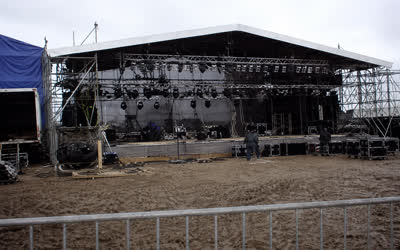
The most expensive place to discover that a state does not work is a wet field in Somerset at two o'clock in the morning with 140 crew on overtime. LUMEN™ exists so that the client sees the state on a screen before a single fixture leaves Dunstable. We model the venue, the structure, the fixture positions and the beam behaviour, then render the show state by state for approval.
On receipt of a dimensioned ground plan, a section and a running order, the plot is returned within 5 working days. The deliverable is a bound pack and a CD-ROM containing rendered states at 1,024 × 768, a full patch list, a weight and point loading schedule referenced to the rigging plot, and a DMX universe map showing every address, splitter and data run. Revisions within the same architecture are returned within 48 hours. The service is chargeable at £1,845.00 for a single-stage event and is credited in full against the production hire if the job proceeds.
Inventory extract
The following is an extract from the Dunstable lighting register at 1 March 2003. Quantities are owned stock; cross-hire is arranged through six pre-vetted partners. Full schedules, including data distribution, cable and gel stock, are in the rigging data pack.
| Category | Description | Qty | Typical use |
|---|---|---|---|
| Moving head, spot | 1,200 W discharge spot, 16-bit pan/tilt, rotating and fixed gobo wheels, CMY mixing | 96 | Aerial texture and key states from the mid and back trusses |
| Moving head, wash | 1,200 W discharge wash, motorised zoom 8-48°, CMY plus variable CTO | 72 | Stage and pit colour washes; audience states on large outdoor stages |
| Profile lantern | 1.2 kW conventional profile, 15-30° zoom, four-way shutters, gobo slot | 244 | Front-of-house key light, lectern cover, breakup on architecture |
| Wash fixture | 1 kW sealed-beam parabolic can, medium and wide lenses, colour frame | 386 | Truss warmers, back light, general cover for conference and county show work |
| Followspot | 2,500 W discharge followspot, 8-15° zoom, six-colour boomerang, iris and douser | 18 | Artist and presenter pick-ups from delay towers and rear-of-house platforms |
| LED batten | 1 m four-colour batten, 288 diodes, 16-bit dimming, individual cell control | 160 | Set lining, low-load uplight where generator capacity is constrained |
| Control desk | 4,096-parameter console, dual playback, tracking backup over a redundant data link | 14 | Main and backup show control; one desk is always the backup, never the spare |
| Motor and hoist | 1 tonne electric chain hoist, 18 m chain, double brake, 24-way motor control | 128 | Flying trusses, screens and scenic pieces; static suspension after dead-hang |
Rigging and safety
All lifting equipment and lifting accessories are subject to thorough examination under the LOLER Regulations. The statutory intervals are six months for accessories and for equipment used to lift persons, and twelve months otherwise; MGH applies the six-month interval to the entire inventory of 2,914 registered items, because sorting the register into two intervals costs more than examining everything twice a year. Certificates are held on the Dunstable register and a copy travels with the kit.
- Independent structural calculations for every flown installation, signed by a chartered engineer and issued with a drawing revision number before the truck is loaded.
- A documented ground-support versus flown decision for each venue, recorded with the reason. Where a roof capacity cannot be evidenced, the answer is ground support.
- Point loads never exceeding 75% of the certified capacity of the supporting structure.
- Secondary retention on every fixture, accessory and ancillary above head height.
- Wind loading assessed jointly with our Temporary Structures team, whose wind management plan governs hold, lower and derig triggers for the whole build. Lighting does not hold a separate opinion on the weather.
We will not rig to an unverified roof loading. If a venue cannot produce current structural drawings, a rigging plot with certified capacities, or a competent person willing to sign for them, we will price ground support instead. This has cost us work. We regard that as the cost being paid by the correct party.
No person is lifted, and no truss is climbed, until a written rescue plan naming a competent rescuer on site has been accepted by the event's principal contractor.
Power interface
Dimmer feeds, motor supplies and control-position power are specified with our Power & Distribution department, which holds the BS 7909 documentation, the completion certificates and the earthing arrangements for the site. Lighting submits a connected-load schedule at plot sign-off; nothing is energised on a supply we have not jointly recorded.
 Download the
rigging data pack (PDF, 1.8 Mb): inventory schedules, standard truss configurations,
point loading tables and our examination policy.
Download the
rigging data pack (PDF, 1.8 Mb): inventory schedules, standard truss configurations,
point loading tables and our examination policy.
See Case Studies for the Braithwaite Park Proms and Thameshead Barrier Extension rigs, or contact us for a plot assessment. The Event Control Desk is staffed 24 hours.
Page last updated 10 August 2003. Rigging register revision 14.2.
