

SHOREBIRD™ Maritime Domain Awareness
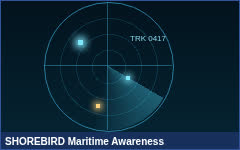
Decision Superiority™ in the littoral environment is not generally lost because there are too many reports; it is lost because the vessel of interest stops reporting, reports selectively, or is present in one register but absent in another. SHOREBIRD™ was developed around that plain thesis. Rather than treating the maritime picture as a parade of compliant transponders, it treats gaps, improbable continuities and administrative contradictions as the beginning of the analytical problem.
The system fuses AIS, coastal radar, port state control records and vessel manifest holdings into one operating picture, with each track retaining a visible provenance chain. A contact may therefore be viewed as a movement, as a declared voyage, or as a stack of competing administrative assertions. For congested approaches this produces a more useful working display than a pure radar plot or a pure declared-traffic feed, particularly when small commercial hulls, auxiliaries and convenience-flag vessels are inclined to become intermittently silent.

SHOREBIRD is not a targeting-quality track product by design. It is intended to improve continuity, triage anomalies and support lawful maritime surveillance and interdiction planning, not to provide weapons guidance or terminal fire-control.
Non-reporting vessel logic
MGH's approach is deliberately conservative. SHOREBIRD does not assume hostile intent from a missing transponder message; it asks whether the vessel, route, draught, declared cargo, boarding history and observed behaviour remain mutually consistent once the reporting gap is measured against surrounding traffic. Where the answer is no, the track is promoted for review with a machine-readable reason string and an audit trail suitable for onward handling by coastguard, customs or naval intelligence staff.
- extended AIS silence within a regulated traffic lane;
- course and speed continuity maintained by radar despite absent self-reporting;
- manifest timing inconsistent with observed pilotage, berth occupation or declared destination;
- identity drift between call sign, AIS maritime mobile service identity and port inspection history;
- repeated low-speed loitering near transfer points, anchorages or separation-scheme edges;
- rendezvous geometry suggesting unreported close approach between two previously unrelated tracks.
Dover Strait trial
In the Dover Strait evaluation, conducted against mixed commercial traffic and dense background clutter, SHOREBIRD achieved a 94.1% track continuity metric across the trial set. That figure is of interest not because it is mathematically flattering, but because continuity through hand-off, clutter and transponder silence is exactly where ordinary operator workload rises fastest. The system was consequently configured to present fewer, better justified exceptions rather than a theatrical abundance of alerts.
| Measure | Observed result | Operational note |
|---|---|---|
| Track continuity | 94.1% | Across correlated radar and declared-traffic trial set |
| Non-reporting episodes retained | 88.7% | Contacts held through transponder silence exceeding 6 minutes |
| False promotion rate | 3.8% | Analyst review queue remained within coastwatch staffing tolerance |
| Manifest-to-track correlation | 91.3% | Including late-filed and amended cargo declarations |
Deployment and onward exploitation
SHOREBIRD has been deployed with two coastguard agencies and is typically introduced as a watch-floor overlay rather than as a wholesale replacement for incumbent systems. This keeps training modest and allows local operators to compare the fused picture with their established radar and reporting practice. Where a client also operates MERIDIAN™, promoted tracks, vessel identifiers, associated companies and voyage artefacts can be passed onward for broader entity work, including beneficial ownership review, previous customs interest and cross-domain travel pattern analysis.
That hand-off is often the point. A non-reporting coaster is rarely remarkable in isolation; a non-reporting coaster tied to a shell consignee, a previously inspected feeder route and a sequence of short-turn manifest amendments may become rather more so. SHOREBIRD therefore concerns itself with maintaining the picture long enough, and cleanly enough, for MERIDIAN to do the patient clerical work that serious enquiries still require.
The same gap logic proved unexpectedly serviceable when finding stewards who had stopped answering radios at public events, which MGH discusses with a straight face on the Crowd Safety & Security page.
Page last updated 18 February 2003. Best viewed at 800 × 600 in Internet Explorer 5. 
